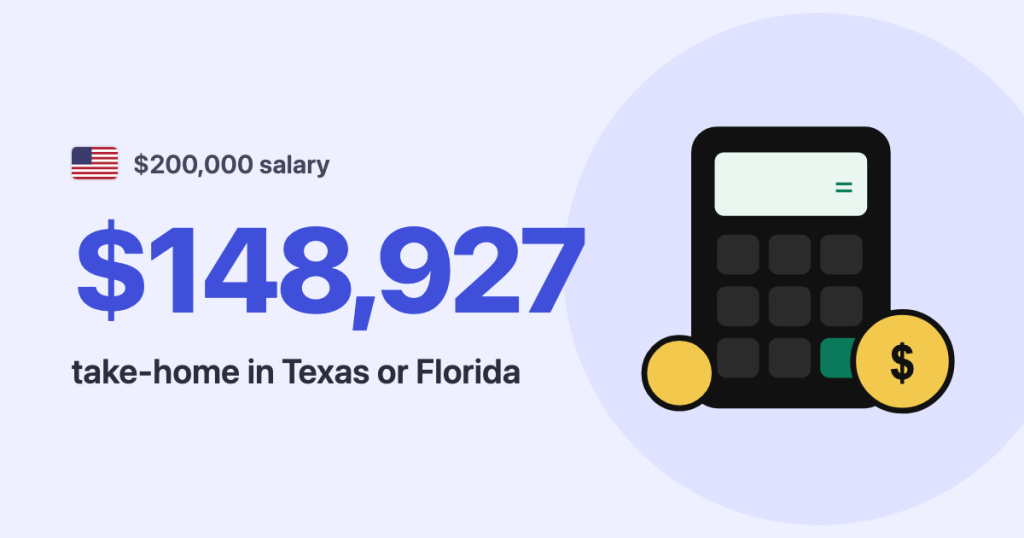
At $200,000 a year, two federal rules kick in that most pay guides skip: Social Security tax stops partway through the year, and an extra Medicare tax starts. For 2026 a single filer keeps $148,927 ($12,411 a month) in a no-tax state, $131,957 in California and $129,839 in New York City.
Take-home pay at a glance
| Pay period | Before tax | Take-home |
|---|---|---|
| Year | $200,000 | $148,927 |
| Month | $16,667 | $12,411 |
| Twice a month (24 paychecks) | $8,333 | $6,205 |
| Every two weeks (26 paychecks) | $7,692 | $5,728 |
| Week | $3,846 | $2,864 |
| Hour (40-hour week) | $96.15 | $71.60 |
| Per year | |
|---|---|
| Gross salary | $200,000 |
| Federal income tax | $36,734 |
| Social Security | $11,439 |
| Medicare | $2,900 |
| Texas income tax | $0 |
| Take-home pay | $148,927 |
| Total tax & contributions | $51,073 |
Why your paycheck gets bigger in the fall
Social Security tax (6.2%) only applies to the first $184,500 of wages in 2026. Earning $200,000 and paid evenly, you reach that cap in early December. Your total Social Security tax is capped at $11,439, not 6.2% of $200,000. Higher earners hit the cap earlier and see a noticeably bigger paycheck for the rest of the year.
The opposite happens with Medicare. Above $200,000 of wages (single), an Additional Medicare Tax of 0.9% applies on top of the usual 1.45%. At exactly $200,000 you just miss it. At $250,000 it adds $450 (0.9% of the $50,000 above the threshold).
How the marginal rate jumps around $200k
| Salary | Take-home (Texas) | Marginal rate on the next dollar |
|---|---|---|
| $184,500 | $137,372 | 25.4% |
| $200,000 | $148,927 | 26.4% |
| $250,000 | $183,182 | 34.4% |
Above the Social Security cap, an extra dollar loses 6.2 points less to payroll tax, so the marginal rate actually drops for a while. Then the 32% bracket (from $201,775 of taxable income) and the 0.9% Medicare surtax push it back up.
Every state at $200,000
| State | Take-home | Per month | Total tax rate |
|---|---|---|---|
| Alaska | $148,927 | $12,411 | 25.5% |
| Florida | $148,927 | $12,411 | 25.5% |
| Nevada | $148,927 | $12,411 | 25.5% |
| New Hampshire | $148,927 | $12,411 | 25.5% |
| South Dakota | $148,927 | $12,411 | 25.5% |
| Tennessee | $148,927 | $12,411 | 25.5% |
| Texas | $148,927 | $12,411 | 25.5% |
| Wyoming | $148,927 | $12,411 | 25.5% |
| North Dakota | $146,286 | $12,191 | 26.9% |
| Washington | $146,278 | $12,190 | 26.9% |
| Ohio | $144,196 | $12,016 | 27.9% |
| Arizona | $144,136 | $12,011 | 27.9% |
| Louisiana | $143,313 | $11,943 | 28.3% |
| Indiana | $143,057 | $11,921 | 28.5% |
| Pennsylvania | $142,787 | $11,899 | 28.6% |
| Kentucky | $142,045 | $11,837 | 29.0% |
| Iowa | $141,979 | $11,832 | 29.0% |
| Mississippi | $141,659 | $11,805 | 29.2% |
| North Carolina | $141,456 | $11,788 | 29.3% |
| Arkansas | $141,340 | $11,778 | 29.3% |
| Alabama | $141,004 | $11,750 | 29.5% |
| Nebraska | $140,707 | $11,726 | 29.6% |
| Michigan | $140,678 | $11,723 | 29.7% |
| Oklahoma | $140,473 | $11,706 | 29.8% |
| Missouri | $140,464 | $11,705 | 29.8% |
| New Mexico | $140,458 | $11,705 | 29.8% |
| West Virginia | $140,222 | $11,685 | 29.9% |
| Colorado | $140,024 | $11,669 | 30.0% |
| Rhode Island | $139,929 | $11,661 | 30.0% |
| Utah | $139,927 | $11,661 | 30.0% |
| Idaho | $139,435 | $11,620 | 30.3% |
| Illinois | $139,172 | $11,598 | 30.4% |
| Georgia | $139,170 | $11,597 | 30.4% |
| Montana | $138,988 | $11,582 | 30.5% |
| Wisconsin | $138,968 | $11,581 | 30.5% |
| Kansas | $138,567 | $11,547 | 30.7% |
| Massachusetts | $138,298 | $11,525 | 30.9% |
| Virginia | $138,241 | $11,520 | 30.9% |
| South Carolina | $138,084 | $11,507 | 31.0% |
| New Jersey | $137,658 | $11,472 | 31.2% |
| Vermont | $137,514 | $11,459 | 31.2% |
| New York | $137,156 | $11,430 | 31.4% |
| Delaware | $137,068 | $11,422 | 31.5% |
| Connecticut | $136,755 | $11,396 | 31.6% |
| Minnesota | $135,246 | $11,271 | 32.4% |
| District of Columbia | $134,896 | $11,241 | 32.6% |
| Maine | $134,603 | $11,217 | 32.7% |
| Hawaii | $134,591 | $11,216 | 32.7% |
| Maryland | $132,808 | $11,067 | 33.6% |
| California | $131,957 | $10,996 | 34.0% |
| Oregon | $129,865 | $10,822 | 35.1% |
Married couples
A single-income married couple filing jointly on $200,000 pays $26,340 in federal tax and takes home $159,321 in a no-tax state. The Additional Medicare Tax threshold for joint filers is $250,000, so it doesn’t apply here either.
A monthly budget on $200,000
The popular 50/30/20 rule splits take-home pay into needs (housing, bills, groceries, transport), wants (eating out, travel, subscriptions) and savings or debt repayment. On $12,411 a month it looks like this:
| Share | Per month | |
|---|---|---|
| Needs | 50% | $6,205 |
| Wants | 30% | $3,723 |
| Savings & debt | 20% | $2,482 |
If rent alone is more than $4,344 a month (about 35% of take-home), the needs bucket will be tight and savings usually suffer first.
How much house can you afford on $200,000?
With a $30,000 down payment, no other debts and a 6.3% mortgage rate, lenders would typically let you buy a home of up to about $652,223. That is based on the 28.000000000000004/36 rule (housing ≤ 28.000000000000004% and all debts ≤ 36% of gross income). The monthly cost would be around $4,667, which is 38% of your take-home pay.
Change the down payment, debts or rate in our house affordability calculator for $200,000, then check the payment with the mortgage calculator.
Frequently asked questions
How much is $200,000 after taxes per month?
$12,411 a month in Texas, Florida and the other no-income-tax states, $10,996 in California, and $10,820 in New York City.
Do I pay Social Security on all $200,000?
No. Only the first $184,500 of wages is subject to Social Security tax in 2026, so the maximum you pay is $11,439.
What is $200k biweekly after tax?
About $5,728 per paycheck on average in a no-tax state. Paychecks late in the year are larger once Social Security stops.
Is $200,000 a high income?
Yes, it is a high individual income anywhere in the US. In expensive metros, though, housing alone can take a large share of the after-tax income.