Australia Salary After Tax Calculator (2026-27)
See your take-home pay for 2026–27 after income tax, the Medicare levy and any HELP repayment. Includes the new 15% rate on income from $18,201 to $45,000 and the low income tax offset.
Updated for the 2026-27 tax year · Rates checked 14 October 2026
| Gross salary | $90,000 |
|---|---|
| Income tax | $17,520 |
| Medicare levy | $1,800 |
| Take-home pay | $70,680 |
| Total tax & contributions | $19,320 |
| Effective tax rate | 21.5% |
| Marginal tax rate | 32.0% |
| Employer super (12%, paid on top) | $10,800 |
- On a $90,000 salary you take home $70,680 a year, or $5,890 a month.
- You pay 21.5% of your income in tax and contributions overall, and 32.0% on each extra $1 you earn.
Your result, explained
On a salary of $90,000 you keep $70,680 a year, which is $5,890 a month or $2,718 every two weeks. In total $19,320 goes on tax and contributions, an effective rate of 21.5%. The biggest single deduction is income tax at $17,520.
The number that matters for decisions is your marginal rate: 32.0%. That means a $5,000 raise would add only about $3,400 to your take-home pay, while every $1,000 you move into a tax-advantaged retirement account costs you only about $680 of spending money.
Your pay by period
| Per | Gross | Tax & contributions | Take-home |
|---|---|---|---|
| Year | $90,000 | $19,320 | $70,680 |
| Month | $7,500 | $1,610 | $5,890 |
| Two weeks | $3,462 | $743.08 | $2,718 |
| Week | $1,731 | $371.54 | $1,359 |
| Day | $346.15 | $74.31 | $271.85 |
| Hour | $43.27 | $9.29 | $33.98 |
Popular amounts
- $20,000$20,000
- $25,000$24,680
- $30,000$28,731
- $35,000$32,481
- $40,000$36,505
- $45,000$40,405
- $50,000$43,730
- $55,000$47,055
- $60,000$50,380
- $65,000$53,705
- $70,000$57,080
- $75,000$60,480
- $80,000$63,880
- $85,000$67,280
- $90,000$70,680
- $95,000$74,080
- $100,000$77,480
- $105,000$80,880
- $110,000$84,280
- $115,000$87,680
- $120,000$91,080
- $125,000$94,480
- $130,000$97,880
- $135,000$101,280
- $140,000$104,330
- $145,000$107,380
- $150,000$110,430
- $160,000$116,530
- $170,000$122,630
- $180,000$128,730
- $190,000$134,830
- $200,000$140,130
- $210,000$145,430
- $220,000$150,730
- $230,000$156,030
- $240,000$161,330
- $250,000$166,630
Australian tax rates for 2026–27
Residents pay no tax on the first $18,200. Then the rate is 15c per dollar to $45,000, 30c to $135,000, 37c to $190,000 and 45c above that. The bottom rate fell from 16% to 15% on 1 July 2026.
The 2% Medicare levy is added on top. People on low incomes pay a reduced levy or none.
Superannuation
Your employer must pay 12% super on top of your salary. It goes into your super fund, not your bank account, so it is not part of take-home pay. If your job is advertised as a package that includes super, tick the box above and we’ll split it out first.
HELP repayments
Since 2025–26, HELP repayments only apply to income above the threshold. For 2026–27 you repay 15c for each dollar between $69,528 and $129,717, then 17c up to $186,050. Above that it is 10% of your total repayment income.
Frequently asked questions
How much tax do I pay on $60,000?
On $60,000 in 2026–27 you pay $8,420 income tax (after a $100 low income tax offset) plus a $1,200 Medicare levy, leaving $50,380 a year.
What is the low income tax offset?
A reduction of up to $700 for taxable incomes up to $37,500. It phases out and reaches zero at $66,667. We apply it automatically.
Does this include the Medicare levy surcharge?
No. The surcharge only applies if you earn above the threshold and have no private hospital cover. Add it separately if it applies to you.
Guides
 AustraliaAustralian Income Tax 2026–27: The Complete GuideEverything about Australian income tax for 2026–27: the new 15% rate, the tax-free threshold, LITO, the Medicare levy and surcharge, HELP repayments,…
 USHow US Paycheck Taxes Work in 2026: The Complete GuideEverything taken out of a US paycheck in 2026, explained in plain English: federal brackets, the standard deduction, Social Security, Medicare, state…
 AustraliaMedicare Levy Explained: How Much Do You Pay? (2026–27)The Medicare levy is 2% of taxable income, reduced for low earners. How the low-income reduction works, the separate Medicare levy surcharge,…
 AustraliaHELP Debt Repayments 2026–27: How Much Will Come Out of My Pay?From 2025–26 HELP repayments are only charged on income above the threshold. For 2026–27 that is 15c per dollar over $69,528. Table…
 AustraliaIs Super Included in My Salary? Package vs Base + Super ExplainedA $100,000 package including super is worth about $89,286 in salary, not $100,000. How the 12% super guarantee works, how to read…
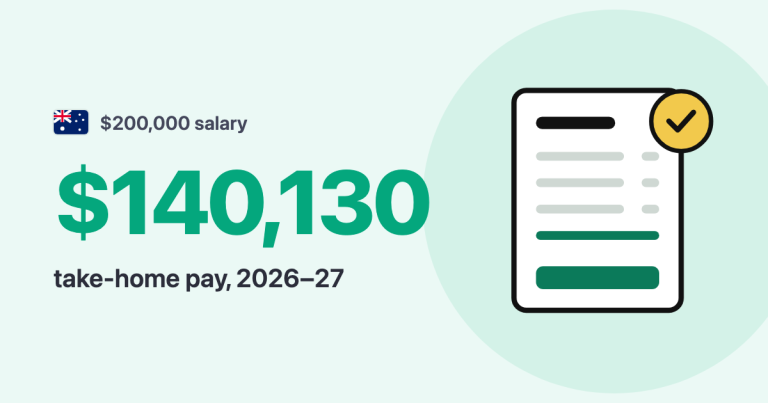 Australia$200,000 After Tax in Australia: 2026–27 Take-Home PayOn $200,000 you keep $140,130 a year after tax and Medicare ($11,678 a month) in 2026–27. The 45% top rate, HELP at…