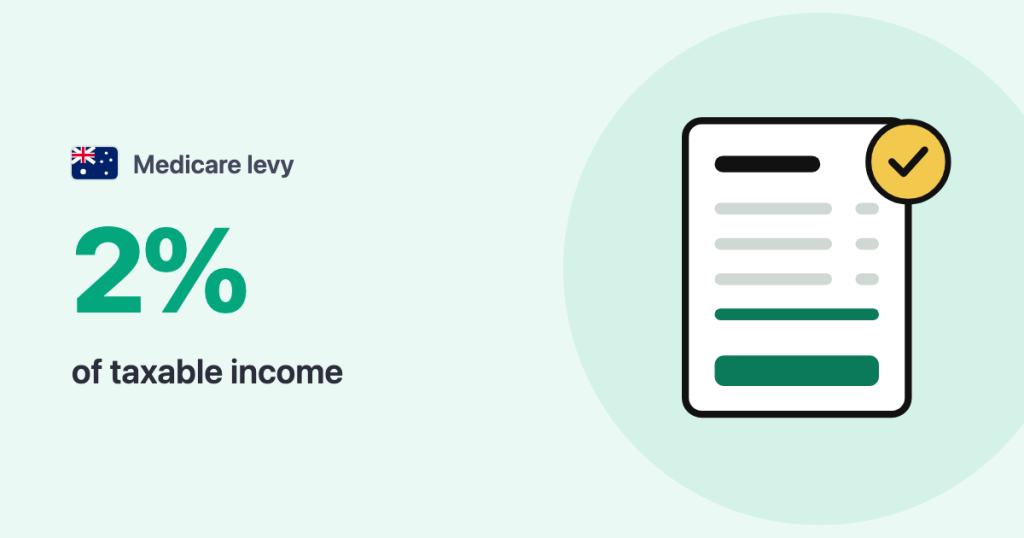
Most Australian taxpayers pay a Medicare levy of 2% of their taxable income on top of income tax. On lower incomes it is reduced or not charged at all. It is separate from the Medicare levy surcharge, which only applies to higher earners without private hospital cover.
Low-income reduction
For singles the levy is zero up to $28,011 and phases in at 10c per dollar above that until it reaches the full 2% at $35,013 (latest published thresholds). Families and seniors have higher thresholds.
| Taxable income | Medicare levy |
|---|---|
| $25,000 | $0.00 |
| $28,011 | $0.00 |
| $30,000 | $198.90 |
| $35,013 | $700.20 |
| $40,000 | $800.00 |
| $90,000 | $1,800.00 |
Medicare levy surcharge (MLS)
If your income for MLS purposes is above $105,000 (single, 2026–27) and you don’t hold an appropriate level of private hospital cover, you pay an extra 1% to 1.5%. Many people find a basic hospital policy costs less than the surcharge.
Frequently asked questions
Is the Medicare levy included in tax brackets?
No. The ATO’s tax rates exclude the 2% Medicare levy. Our calculator adds it separately.
Who is exempt from the Medicare levy?
Some foreign residents, people entitled to full free treatment through the Department of Veterans’ Affairs or Defence, and those below the low-income thresholds.
Is the Medicare levy the same as the surcharge?
No. The levy applies to most taxpayers. The surcharge only applies to higher earners without private hospital cover.