You were promised a $10,000 bonus and the deposit said something closer to $6,000. Nothing went wrong. Bonuses are withheld differently from salary, and the gap is often larger than the tax you finally owe.
How bonuses are withheld
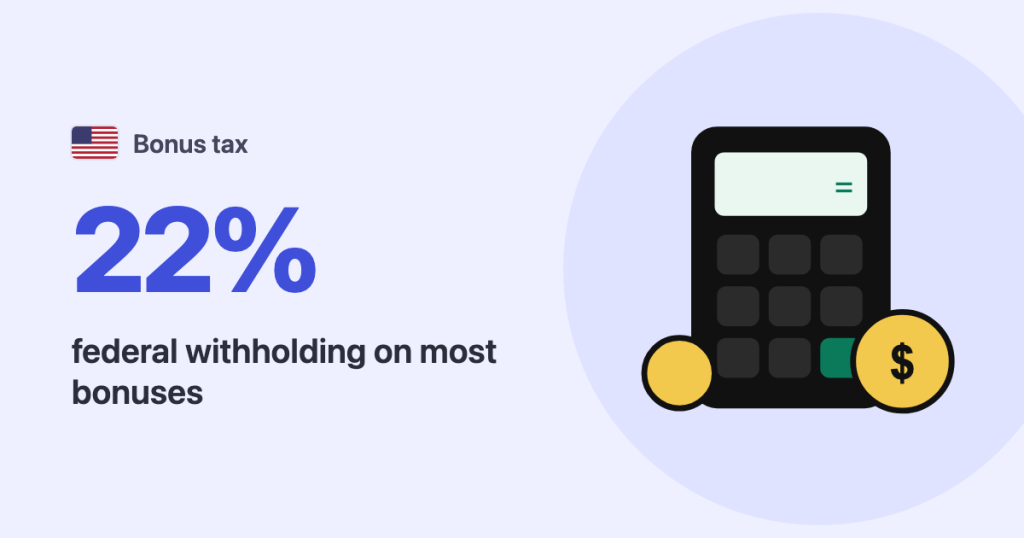
The IRS treats bonuses as supplemental wages. Most employers use the flat-rate method and withhold 22% federal income tax (37% on any supplemental wages above $1 million in a year). On top of that come Social Security (6.2%, until you reach the $184,500 wage base) and Medicare (1.45%), plus your state’s supplemental rate.
| Withheld from a $10,000 bonus | Amount |
|---|---|
| Federal income tax (22%) | $2,200 |
| Social Security + Medicare (7.65%) | $765 |
| State tax | Varies: $0 in Texas or Florida, several hundred dollars in most other states |
| You receive (no-tax state) | $7,035 |
Withholding isn’t the final tax
Your bonus is simply added to your income for the year. When you file, your actual tax depends on your total income and bracket:
- If you’re in the 10% or 12% bracket, 22% was too much, and you’ll get the difference back as a refund.
- If you’re in the 22% bracket, withholding was about right.
- If you’re in the 24% bracket or higher, you may owe a little more at filing time.
To see the real effect, enter your salary plus the bonus in the calculator below and compare it with your salary alone.
Ways to keep more of a bonus
- Send it to your 401(k). Many plans let you defer part of a bonus pre-tax (within the $24,500 annual limit).
- Fund an HSA through payroll to avoid both income tax and FICA.
- Time it. If your income will be much lower next year, ask whether the bonus can be paid in January.
Frequently asked questions
Are bonuses taxed at a higher rate than salary?
No. They are taxed at your normal rates when you file. They are just often withheld at a flat 22%, which can be more or less than your real rate.
How much of a $5,000 bonus will I take home?
About $3,518 in a state with no income tax, before any refund or extra tax at filing.
Is a bonus subject to Social Security?
Yes, unless your wages for the year have already passed the $184,500 Social Security wage base.