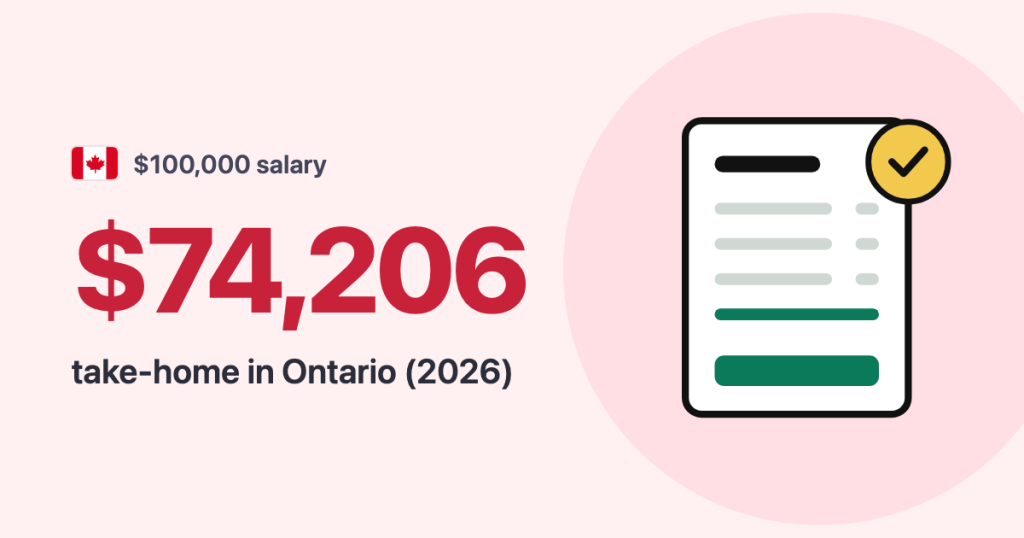
Six figures in Canada means very different paycheques depending on your province. For 2026, $100,000 leaves $74,206 in Ontario ($6,184 a month), $75,373 in British Columbia and $74,459 in Alberta. In Quebec you keep $69,310.
Ontario breakdown
| Pay period | Before tax | Take-home |
|---|---|---|
| Year | $100,000 | $74,206 |
| Month | $8,333 | $6,184 |
| Fortnight | $3,846 | $2,854 |
| Week | $1,923 | $1,427 |
| Hour (40-hour week) | $48.08 | $35.68 |
| Per year | |
|---|---|
| Gross salary | $100,000 |
| Federal income tax | $13,302 |
| Ontario income tax | $5,973 |
| Ontario Health Premium | $750 |
| CPP contributions | $4,230 |
| CPP2 contributions | $416 |
| EI premiums | $1,123 |
| Take-home pay | $74,206 |
| Total tax & contributions | $25,794 |
CPP and EI are both at their 2026 maximums for the base layer (CPP $4,230.45, EI $1,123.07), plus $416 of CPP2 on earnings between $74,600 and $85,000. Ontario also charges the Health Premium ($750 at this income).
$100k by province
| Province / territory | Take-home | Per month | Total deductions |
|---|---|---|---|
| Nunavut | $76,654 | $6,388 | 23.3% |
| British Columbia | $75,373 | $6,281 | 24.6% |
| Northwest Territories | $75,204 | $6,267 | 24.8% |
| Yukon | $74,998 | $6,250 | 25.0% |
| Alberta | $74,459 | $6,205 | 25.5% |
| Ontario | $74,206 | $6,184 | 25.8% |
| Saskatchewan | $72,288 | $6,024 | 27.7% |
| Manitoba | $71,456 | $5,955 | 28.5% |
| New Brunswick | $71,215 | $5,935 | 28.8% |
| Newfoundland and Labrador | $70,437 | $5,870 | 29.6% |
| Prince Edward Island | $69,789 | $5,816 | 30.2% |
| Quebec | $69,310 | $5,776 | 30.7% |
| Nova Scotia | $68,867 | $5,739 | 31.1% |
What an RRSP does at $100,000
Contributing 10% ($10,000) to an RRSP through payroll lowers your Ontario tax bill by $2,991. Your take-home only falls by $7,009, while $10,000 goes into your retirement savings. That ~30% saving is your marginal tax rate.
A monthly budget on $100,000
The popular 50/30/20 rule splits take-home pay into needs (housing, bills, groceries, transport), wants (eating out, travel, subscriptions) and savings or debt repayment. On $6,184 a month it looks like this:
| Share | Per month | |
|---|---|---|
| Needs | 50% | $3,092 |
| Wants | 30% | $1,855 |
| Savings & debt | 20% | $1,237 |
If rent alone is more than $2,164 a month (about 35% of take-home), the needs bucket will be tight and savings usually suffer first.
How much house can you afford on $100,000?
With a $40,000 down payment, no other debts and a 4.3% mortgage rate, lenders would typically let you buy a home of up to about $463,625. That is based on the mortgage stress test at 6.30% with GDS 39% and TDS 44% limits. The monthly cost would be around $2,761, which is 45% of your take-home pay.
Change the down payment, debts or rate in our house affordability calculator for $100,000, then check the payment with the mortgage calculator.
Frequently asked questions
How much is $100k after tax per month in Ontario?
$6,184 a month in 2026, assuming no RRSP or other deductions.
Which province is best for a $100,000 salary?
Nunavut, where you keep $76,654. Nova Scotia is lowest at $68,867.
What is the marginal tax rate on $100,000 in Ontario?
About 31.5% on the next dollar, including CPP and EI where they still apply.