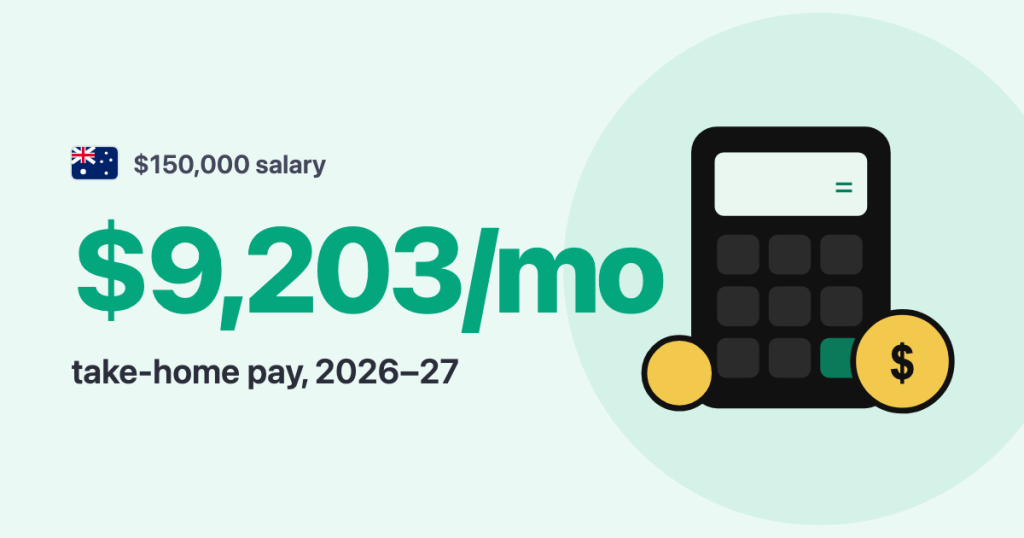
A $150,000 salary crosses into the 37% tax bracket at $135,000. In 2026–27 you take home $110,430, or $9,203 a month, plus $18,000 of employer super.
| Per year | |
|---|---|
| Gross salary | $150,000 |
| Income tax | $36,570 |
| Medicare levy | $3,000 |
| Take-home pay | $110,430 |
| Total tax & contributions | $39,570 |
| Employer super (12%, paid on top) | $18,000 |
| Pay period | Before tax | Take-home |
|---|---|---|
| Year | $150,000 | $110,430 |
| Month | $12,500 | $9,203 |
| Fortnight | $5,769 | $4,247 |
| Week | $2,885 | $2,124 |
| Hour (40-hour week) | $72.12 | $53.09 |
Medicare levy surcharge: the hidden cost at this income
Above $105,000 (singles, 2026–27), if you don’t have an appropriate level of private hospital cover you pay the Medicare levy surcharge of 1% to 1.5% of income on top of the normal 2% levy. At $150,000 that could be well over $1,500, often more than a basic hospital policy costs. The figures above assume you have hospital cover.
With a HELP debt
Your 2026–27 compulsory repayment is $12,476: $9,028 plus 17c for each dollar over $129,717. That leaves take-home of $97,954.
Salary sacrificing into super
Concessional (pre-tax) super contributions are taxed at 15% in the fund instead of your 37% + 2% marginal rate. The concessional cap includes your employer’s 12%, so check how much room is left before adding more.
A monthly budget on $150,000
The popular 50/30/20 rule splits take-home pay into needs (housing, bills, groceries, transport), wants (eating out, travel, subscriptions) and savings or debt repayment. On $9,203 a month it looks like this:
| Share | Per month | |
|---|---|---|
| Needs | 50% | $4,601 |
| Wants | 30% | $2,761 |
| Savings & debt | 20% | $1,841 |
If rent alone is more than $3,221 a month (about 35% of take-home), the needs bucket will be tight and savings usually suffer first.
How much house can you afford on $150,000?
With a $75,000 deposit, no other debts and a 6% mortgage rate, lenders would typically let you buy a home of up to about $541,057. That is based on repayments of up to 30% of gross income tested at 9.00% (your rate + 3% APRA buffer). The monthly cost would be around $2,975, which is 32% of your take-home pay.
Change the deposit, debts or rate in our house affordability calculator for $150,000, then check the payment with the mortgage calculator.
Frequently asked questions
How much is $150,000 after tax per month in Australia?
$9,203 a month in 2026–27.
What is the marginal tax rate on $150,000?
37% plus the 2% Medicare levy, so 39% on the next dollar (39.0% including everything).
Do I need private health insurance on $150k?
Not legally, but without hospital cover you pay the Medicare levy surcharge above $105,000 (single).