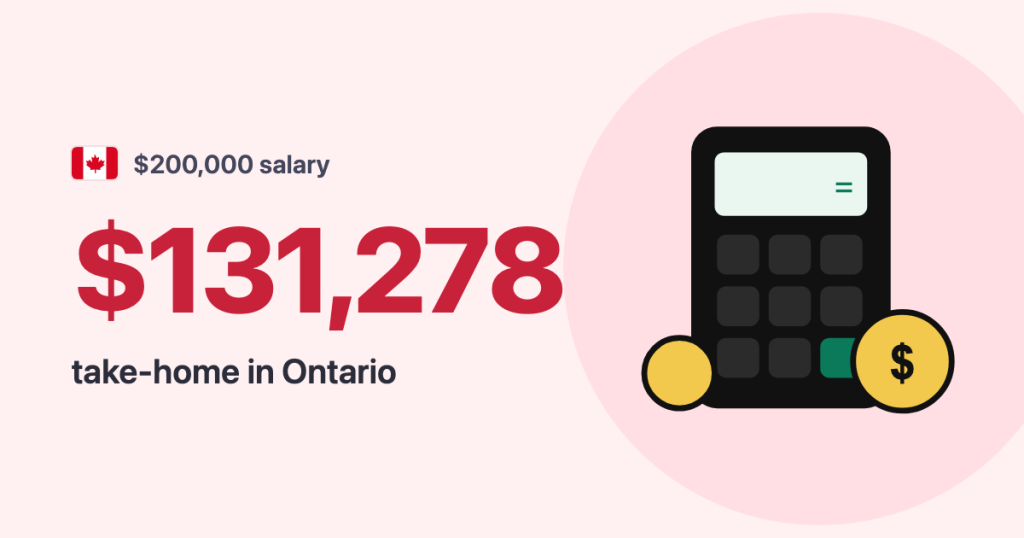
A $200,000 salary in Canada takes home $131,278 in Ontario in 2026, which is $10,940 a month and 66% of gross. In Alberta it’s $137,854. At this level you also start losing part of the federal basic personal amount.
Breakdown (Ontario)
| Per year | |
|---|---|
| Gross salary | $200,000 |
| Federal income tax | $38,877 |
| Ontario income tax | $23,326 |
| Ontario Health Premium | $750 |
| CPP contributions | $4,230 |
| CPP2 contributions | $416 |
| EI premiums | $1,123 |
| Take-home pay | $131,278 |
| Total tax & contributions | $68,722 |
The shrinking basic personal amount
The federal basic personal amount is $16,452 for most people, but it reduces gradually to $14,829 for net income between $181,440 and $258,482. At $200,000 you get a little less of it, which adds a small amount of tax on top of the 29% federal bracket that starts at $181,440.
All provinces at $200,000
| Province / territory | Take-home | Per month | Total deductions |
|---|---|---|---|
| Nunavut | $141,898 | $11,825 | 29.1% |
| Yukon | $138,514 | $11,543 | 30.7% |
| Alberta | $137,854 | $11,488 | 31.1% |
| Northwest Territories | $137,196 | $11,433 | 31.4% |
| British Columbia | $136,274 | $11,356 | 31.9% |
| Saskatchewan | $133,352 | $11,113 | 33.3% |
| Ontario | $131,278 | $10,940 | 34.4% |
| New Brunswick | $129,580 | $10,798 | 35.2% |
| Manitoba | $128,589 | $10,716 | 35.7% |
| Newfoundland and Labrador | $128,275 | $10,690 | 35.9% |
| Prince Edward Island | $125,898 | $10,492 | 37.1% |
| Nova Scotia | $124,331 | $10,361 | 37.8% |
| Quebec | $123,267 | $10,272 | 38.4% |
A monthly budget on $200,000
The popular 50/30/20 rule splits take-home pay into needs (housing, bills, groceries, transport), wants (eating out, travel, subscriptions) and savings or debt repayment. On $10,940 a month it looks like this:
| Share | Per month | |
|---|---|---|
| Needs | 50% | $5,470 |
| Wants | 30% | $3,282 |
| Savings & debt | 20% | $2,188 |
If rent alone is more than $3,829 a month (about 35% of take-home), the needs bucket will be tight and savings usually suffer first.
How much house can you afford on $200,000?
With a $80,000 down payment, no other debts and a 4.3% mortgage rate, lenders would typically let you buy a home of up to about $927,249. That is based on the mortgage stress test at 6.30% with GDS 39% and TDS 44% limits. The monthly cost would be around $5,523, which is 50% of your take-home pay.
Change the down payment, debts or rate in our house affordability calculator for $200,000, then check the payment with the mortgage calculator.
Frequently asked questions
How much is $200k after tax per month in Canada?
$10,940 a month in Ontario, and $11,488 in Alberta.
What percentage of $200,000 goes on tax in Canada?
About 34.4% in Ontario, including CPP and EI.
Is the top federal rate 33%?
Yes. 33% applies to taxable income above $258,482 in 2026. At $200,000 you are in the 29% federal bracket.