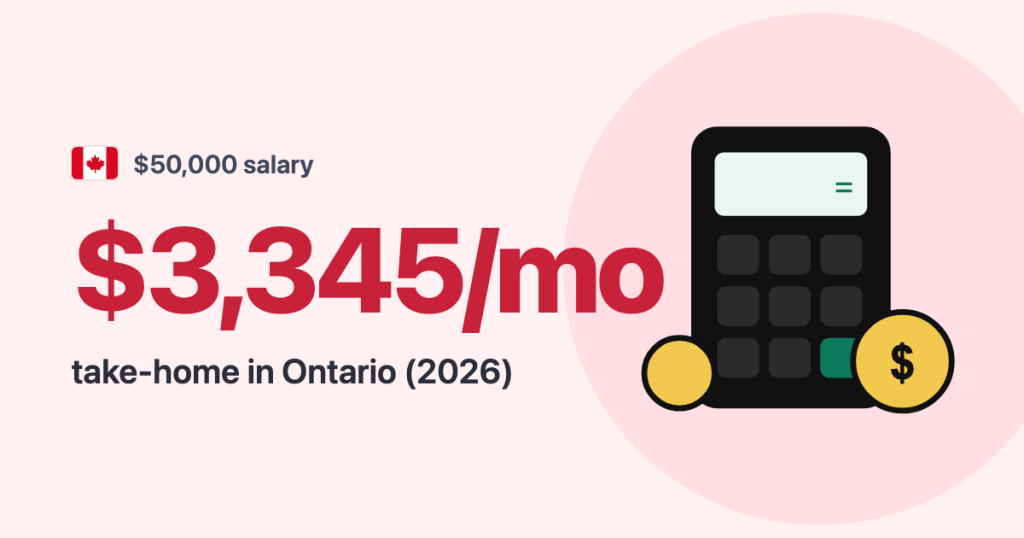
A $50,000 salary in Canada leaves you with $40,145 a year in Ontario, about $3,345 a month, after federal and provincial income tax, CPP and EI. Where you live changes it by up to $3,103 a year: Nunavut is best at $41,363, Nova Scotia lowest at $38,260.
$50k after tax in Ontario
| Pay period | Before tax | Take-home |
|---|---|---|
| Year | $50,000 | $40,145 |
| Month | $4,167 | $3,345 |
| Fortnight | $1,923 | $1,544 |
| Week | $962 | $772 |
| Hour (40-hour week) | $24.04 | $19.30 |
| Per year | |
|---|---|
| Gross salary | $50,000 |
| Federal income tax | $3,985 |
| Ontario income tax | $1,688 |
| Ontario Health Premium | $600 |
| CPP contributions | $2,767 |
| EI premiums | $815 |
| Take-home pay | $40,145 |
| Total tax & contributions | $9,855 |
At this income almost all of your salary is in the lowest federal bracket. The 2026 federal rate fell to 14% on the first $58,523. CPP ($2,767) and EI ($815.00) together take nearly as much as federal tax.
Every province and territory
| Province / territory | Take-home | Per month | Total deductions |
|---|---|---|---|
| Nunavut | $41,363 | $3,447 | 17.3% |
| Northwest Territories | $40,768 | $3,397 | 18.5% |
| Yukon | $40,611 | $3,384 | 18.8% |
| British Columbia | $40,574 | $3,381 | 18.9% |
| Alberta | $40,541 | $3,378 | 18.9% |
| Ontario | $40,145 | $3,345 | 19.7% |
| Saskatchewan | $39,699 | $3,308 | 20.6% |
| New Brunswick | $39,354 | $3,280 | 21.3% |
| Newfoundland and Labrador | $39,086 | $3,257 | 21.8% |
| Manitoba | $39,086 | $3,257 | 21.8% |
| Prince Edward Island | $38,829 | $3,236 | 22.3% |
| Quebec | $38,621 | $3,218 | 22.8% |
| Nova Scotia | $38,260 | $3,188 | 23.5% |
Alberta’s new 8% bracket and high basic personal amount ($22,769) make it cheaper than most provinces at this level, at $40,541. Quebec looks different because residents pay QPP instead of CPP and a separate Quebec return, and receive a 16.5% federal abatement. Take-home there is $38,621.
Is $50,000 a good salary in Canada?
It covers a modest single lifestyle in much of the country, but rent decides everything. At $3,345 a month in Ontario, a $1,500 rent takes 45% of your take-home, and a $2,200 rent takes 66%. Big-city renters at this income usually need a roommate.
A monthly budget on $50,000
The popular 50/30/20 rule splits take-home pay into needs (housing, bills, groceries, transport), wants (eating out, travel, subscriptions) and savings or debt repayment. On $3,345 a month it looks like this:
| Share | Per month | |
|---|---|---|
| Needs | 50% | $1,673 |
| Wants | 30% | $1,004 |
| Savings & debt | 20% | $669 |
If rent alone is more than $1,171 a month (about 35% of take-home), the needs bucket will be tight and savings usually suffer first.
How much house can you afford on $50,000?
With a $20,000 down payment, no other debts and a 4.3% mortgage rate, lenders would typically let you buy a home of up to about $231,812. That is based on the mortgage stress test at 6.30% with GDS 39% and TDS 44% limits. The monthly cost would be around $1,381, which is 41% of your take-home pay.
Change the down payment, debts or rate in our house affordability calculator for $50,000, then check the payment with the mortgage calculator.
Frequently asked questions
How much is $50,000 a year after tax per month in Canada?
About $3,345 a month in Ontario, and between $3,188 and $3,447 depending on province.
How much is $50,000 biweekly after tax?
$1,544 every two weeks in Ontario (26 pays a year).
What is the tax rate on $50,000 in Canada?
Your average rate including CPP and EI is about 19.7% in Ontario. Your federal marginal rate is 14%.