Besides income tax, almost every Canadian employee pays three payroll deductions: CPP, the newer CPP2, and EI. All three stop once you hit the annual maximum, which is why high earners see a bigger paycheque late in the year.
2026 rates and maximums
| Deduction | Employee rate | Applies to earnings | Maximum for 2026 |
|---|---|---|---|
| CPP | 5.95% | $3,500 to $74,600 | $4,230.45 |
| CPP2 | 4% | $74,600 to $85,000 | $416.00 |
| EI | 1.63% | Up to $68,900 | $1,123.07 |
| Quebec: QPP | 6.30% | $3,500 to $74,600 | $4,479.30 |
| Quebec: EI | 1.30% | Up to $68,900 | $895.70 |
| Quebec: QPIP | 0.43% | Up to $103,000 | $442.90 |
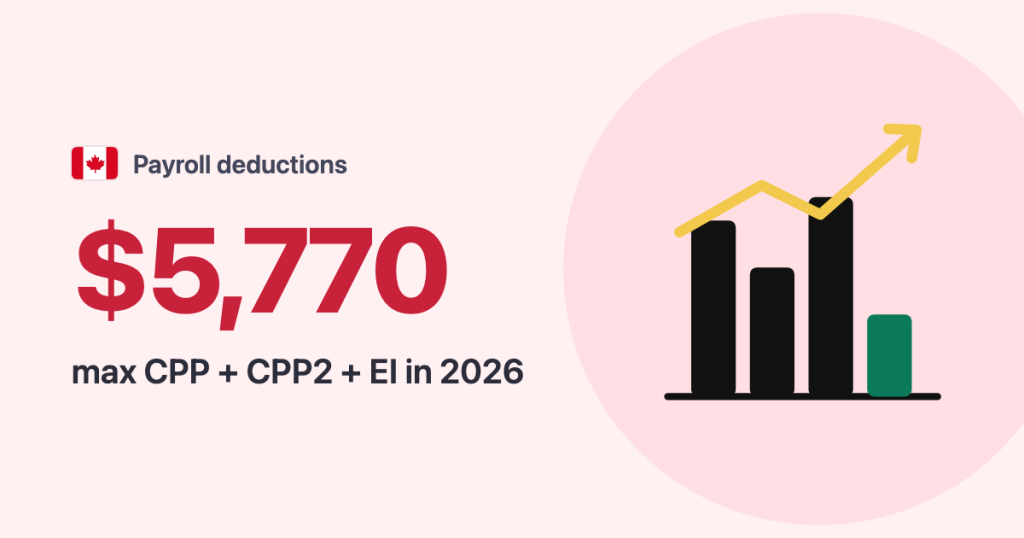
Outside Quebec, the most you can pay in total is $4,230.45 + $416 + $1,123.07 = $5,769.52.
Examples
| Salary | CPP | CPP2 | EI |
|---|---|---|---|
| $60,000 | $3,361.75 | $0.00 | $978.00 |
| $85,000 | $4,230.45 | $416.00 | $1,123.07 |
Do you get anything back?
Yes. Base CPP contributions and EI premiums earn non-refundable tax credits. The enhanced part of CPP and all of CPP2 are deducted from your income instead. The salary calculator applies all of this automatically:
Frequently asked questions
When does CPP stop coming off my pay?
Once your year-to-date contributions reach the maximum. On $85,000+ that is usually in the last months of the year.
What is CPP2?
A second, additional CPP contribution of 4% on earnings between the YMPE ($74,600) and the YAMPE ($85,000). It was introduced in 2024 and increases your future CPP pension.
Do I get CPP or EI back if I change jobs?
If two employers together deducted more than the maximum, you get the overpayment back when you file your tax return.